Electric aviation has long been talked about as the future. Last week at the Farnborough International Airshow, that future moved another step closer.
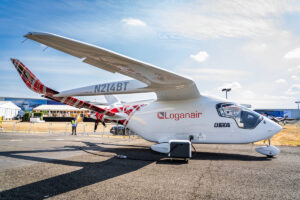
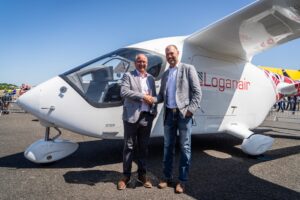
ERAA members Loganair and BETA Technologies announced an agreement that will see the UK’s largest regional airline purchase five all-electric ALIA CX300 conventional take-off and landing (CTOL) aircraft, with options for a further five. If introduced as planned in 2029, Loganair will become Europe’s first commercial airline to operate an electric aircraft fleet.
For regional aviation, the significance goes far beyond a fleet announcement.
Unlike many aircraft orders that are based largely on future expectations, this partnership is built on experience. Earlier this year, Loganair and BETA completed the UK’s first electric flight demonstration programme, operating 23 flights across Scotland’s regional network over 10 days.
The aircraft flew between Glasgow, Dundee, Aberdeen, Inverness, Wick and Kirkwall, covering more than 1,000 nautical miles while demonstrating not only the aircraft’s performance, but also how electric aviation can integrate into existing airport operations, charging infrastructure and regional airspace.
Scotland: the perfect proving ground
Scotland is one of Europe’s most demanding environments for regional aviation. More than 90 inhabited islands and remote Highland communities rely on air services where roads and rail simply cannot provide an alternative. Most of Loganair’s routes are under 100 miles, placing them squarely within the operating range of BETA’s ALIA aircraft.
Speaking at Farnborough, Loganair Chief Executive Luke Farajallah described the airline as “one of the most complex airlines in the world”, with operations that demand constant innovation.
That complexity makes Scotland an ideal proving ground.
Rather than designing a network around a new aircraft, Loganair has demonstrated that electric aviation can fit into the network it already operates. During the trials, the aircraft completed representative passenger and Royal Mail postal flights, showing how lower-emission aircraft could support both community connectivity and essential logistics.
The ALIA CX300 is designed specifically for these short regional missions. It can carry up to five passengers or 567kg of cargo, recharge in around 35 minutes and operate from existing runways, avoiding the need for entirely new airport infrastructure.
Built for the real world
BETA founder and Chief Executive Kyle Clark explained that proving the aircraft in Scottish conditions was fundamental to earning the airline’s confidence.
“Loganair has spent six decades connecting communities that rely on air travel, so their standard for new technology is appropriately high. We met that standard the only way it can be met, by flying more than a thousand nautical miles across their network, on their routes, and in their conditions.”
He also joked that Scotland’s famous weather presented its own engineering challenge.
“It turns out the weather isn’t so great up in Scotland,” he said, explaining that the aircraft had been engineered and certified to cope with lightning and icing conditions before being demonstrated across the network.
For Loganair, the decision is as much about economics as sustainability.
The airline expects electric aircraft to reduce operating costs significantly while eliminating in-flight emissions, creating new opportunities to strengthen essential regional services that connect some of the UK’s most isolated communities.
The partnership also builds on Loganair’s long-standing relationship with Royal Mail, the UK’s national postal service. Earlier demonstration flights successfully carried representative postal loads, highlighting how electric aviation could support both passenger transport and vital public services.
Regional aviation leading the way
For ERAA members, the announcement highlights an increasingly familiar story. Regional aviation is often where new technology proves itself first.
Short sectors, frequent operations and close relationships with local communities make regional airlines uniquely placed to introduce innovations that can later be adopted more widely.
The agreement between Loganair and BETA represents another important step along that journey.
It shows that electric aviation is no longer confined to prototypes, demonstrations or future concepts. It is beginning to transition towards commercial operations, with regional airlines once again leading the way.
For the communities that depend on these connections every day, that could mean a future where essential air services become not only cleaner, but also more efficient, resilient and affordable.