
When Russia launched its full-scale invasion of Ukraine in February 2022, the country’s aviation sector was thrust overnight into unprecedented disruption. Airspace closures, the loss of domestic operations, damaged infrastructure, and the displacement of personnel became immediate realities. For Ukrainian carrier Air Urga, survival was simply the main goal.
Almost four years on, the airline continues to fly international, humanitarian and charter missions, keeping its people employed, operations safe and compliant, and its focus firmly on a future recovery. Behind this resilience stands not only the dedication of Air Urga’s team, but also the steadfast support of trusted partners across the aviation ecosystem.
Adapting operations in wartime
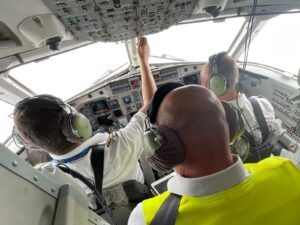
Have you ever wondered what it takes for an airline to cope with a challenging context of a war? From the outset of the war, Air Urga was forced to fundamentally reshape how it operated: reuniting its scattered teams and navigating a web of complex international logistics under constant uncertainty.
As Natalia Klochan from Air Urga’s International Relations Department, explains: “Starting from the tragic day of 24 February 2022, the entire country, and Air Urga in particular, had to continue operating under the realities of war. Our initial goal was simply to survive, which at first seemed nearly impossible. Yet against all odds, we managed to maintain our international operations at a level close to previous years.”
She goes on to describe a profound operational transformation, including overseas maintenance, remote working, virtual collaboration and international crew rotations – all designed to ensure people were paid, supported and able to stay with the company.
“Maintaining aircraft outside our home base and performing all categories of maintenance abroad rather than in Ukraine, required staff to be on-site overseas to supervise processes, co-ordinate with foreign Maintenance, Repair, and Overhaul (MROs), and perform essential liaison functions.”
The logistical and financial burden also grew substantially: “These new realities led to a dramatic increase in operational expenditures, far exceeding pre-war levels. As a result, we had to comprehensively revise and reallocate our budget, restructuring cost categories to ensure that no critical process would halt.”
The war also brought direct, tangible losses. Assets such as aircraft and equipment were damaged during missile attacks on the airline’s hangar, while many employees bravely serving in Ukraine’s Armed Forces, meant the team had to navigate not just danger, but gaps in manpower.
Despite these challenges, Air Urga has continued to sustain its people and safeguard the national economy. Klochan explains: “By keeping jobs intact, we not only support the economic stability of our employees and the region and continue paying taxes to support Ukraine, but we also preserve the country’s professional aviation potential, which will be invaluable for the restoration and development of Ukraine’s civil aviation sector after our victory.”
“Every flight is more than a mission: it is a statement of dedication and a way to sustain both the company and the professional aviation potential of Ukraine.”
Staying sharp under pressure
Flying at a reduced scale doesn’t ease regulatory responsibilities – if anything, it heightens the stakes. Keeping safety systems active, crews sharp, and documentation accurate over prolonged disruption, is essential.
This is where ERA supplier member Wake QA has supported Air Urga, providing independent safety and compliance oversight.
According to Matthew Prior, Senior Manager – Business Development, Wake QA: “Our approach with airlines in these situations in general, is to stabilise the operator’s safety baseline first, then ensure that any adapted or reduced operation continues to meet the same regulatory and operational standards expected of a full schedule.”
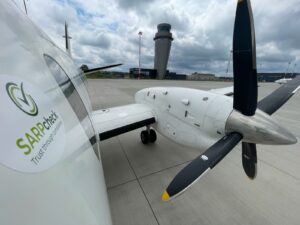
Against this backdrop, the SARPcheck audit – a global audit programme for commercial aviation – played a vital role in helping Air Urga remain safe, compliant and operational. The audit focused on the airline’s core systems, applying a risk-based approach to understand emerging hazards and tailor assurance activities to a reduced but complex operation.
Prior explains surviving disruption isn’t just about getting by, it’s about staying sharp: “Maintain safety systems, keep crews current, audit often, stay transparent with regulators, and be ready to grow when the moment comes. Regional airlines that follow these principles remain resilient and avoid costly recovery phases.”
A partnership built on trust and transparency
Wake QA’s work with Air Urga has helped ensure the airline remains properly licensed and continues to operate safely, despite the challenges of war.
One striking example of adaptive compliance involved mandatory training for Antonov An-26 crews, where the only qualified simulator was located in Russia, making it off-limits. Working with the Ukrainian Civil Aviation Authority, alternative training pathways were validated without compromising safety or standards.
“This is what flexibility looks like”, says Prior. “It’s about meeting ICAO (International Civil Aviation Organization) standards without compromise, even in the toughest circumstances.”
From Air Urga’s perspective, the value of Wake QA’s support lays not in promotion or prescription, but in collaboration, objectivity and continuous improvement.
“What we value most about Wake QA’s support is their comprehensive review of our procedures and documentation which was conducted as part of the closure process of the SARPcheck audit. Their communication style is transparent, constructive, and collaborative, which has been especially valuable throughout the audit process.”
This type of relationship is particularly critical for airlines operating under prolonged uncertainty, where readiness today determines viability tomorrow.
Flying with purpose
For Air Urga’s teams, continuing to fly is about far more than sustaining operations. It’s about preserving professionalism, purpose, and national capability.
“In this sense, every flight is more than a mission: it is a statement of dedication and a way to sustain both the company and the professional aviation potential of Ukraine,” shares Klochan.
Despite everything it has endured, Air Urga remains firmly focused on the future, with plans to modernise its fleet, expand services, and strengthen its international presence when conditions allow.
And their final message is clear: “Air Urga is here to stay – resilient and forward-looking and developing, committed to our passengers, clients, partners, and the broader aviation community.”