
Most of us only think about air connectivity when it isn’t there. When a cancelled flight means a missed meeting or a disrupted holiday, it’s enough to remind us how much we rely on aviation.
But in the Azores, where nine islands are scattered across the Atlantic, flying isn’t simply convenient; it’s essential. It underpins everything from healthcare and education to tourism, business and family life.
This year, as SATA Group marks its 85th anniversary, the airline reflects on more than eight decades of connecting the islands with each other, mainland Portugal and the wider world, a responsibility that continues to shape every decision the group makes.
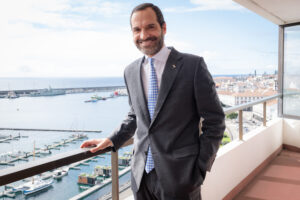
As SATA Group CEO Tiago Santos explains: “SATA assumes a strong social responsibility role: ensuring access to healthcare, enabling family reunification, supporting education mobility, and facilitating the transport of essential goods.”
While SATA Air Açores provides year-round lifeline connections, Azores Airlines competes in international markets, helping to generate the revenue needed to sustain those vital services.
That ethos, Santos explains, is central to how SATA sees its role: “Balancing commercial viability with public service obligations is more than a challenge, it has become a core element of SATA’s identity and purpose.”
When geography shapes every decision
Running an airline is rarely straightforward. Running one in the middle of the Atlantic is another matter entirely.
“Operating in the Azores means dealing daily with a complex set of structural and operational constraints,” Santos shares.
The weather has a habit of making its own plans. Fog can roll in without warning, Atlantic winds can ground aircraft, and rapidly changing conditions regularly test schedules and crews alike.
Even when the weather behaves, the infrastructure presents its own challenges. Some airports have short runways, restricted operating hours or can only operate during daylight, leaving little room to recover when disruption strikes.
Those operational realities also shape SATA’s approach to sustainability. Like every carrier, the airline is committed to reducing its environmental impact, but Santos believes the pace of change must recognise the particular constraints of operating in a remote island region.
“Emerging solutions – such as sustainable aviation fuels (SAFs) or new propulsion technologies – are still in the early stages of scaling up and are particularly difficult to implement in remote regions due to limited availability and higher costs.”
These challenges, he argues, highlight the need for a more tailored aviation policy.
“A priority would be stronger recognition of the specific realities of outermost regions, such as the Azores, within EU aviation policy frameworks.”
That principle extends beyond decarbonisation. From Public Service Obligations (PSOs) to State aid frameworks, Santos says aviation policy needs to better reflect the realities faced by regions where air links are fundamental to everyday life, even when routes are not commercially viable.
Growing tourism without losing what makes the Azores special
The Azores have become one of Europe’s most sought-after destinations, but Santos is clear that growth shouldn’t come at any cost.
“Connectivity is a powerful driver of economic and social development, but in island environments it must be managed with particular care.”
Rather than simply adding more flights during peak season, the focus is on creating a more balanced pattern of demand throughout the year.
“Airlines have a role to play by promoting more balanced traffic patterns – encouraging year-round demand, diversifying routes and avoiding excessive concentration in peak periods.”
Looking ahead, Santos sees opportunities to strengthen the Azores’ role as a mid-Atlantic gateway, building on the islands’ growing international appeal and reinforcing links with North America. But he is clear that growth must support, rather than replace, SATA’s public service mission.
“As a regional airline with deep roots in the community, we must ensure continuity, reliability and accessibility, even when demand fluctuates or profitability is not guaranteed.”
More than an airline
Spend a few minutes talking to Tiago Santos and one thing becomes clear: he doesn’t describe SATA as simply an airline.
He talks about responsibility. He talks about community. Above all, he talks about purpose.
“Leading SATA is not simply about managing an airline. It is about serving a community and a territory that depends on connectivity for their social and economic wellbeing.”
It’s an outlook that reflects the airline’s history as much as its future.
“For 85 years, SATA has carried far more than passengers. Being part of that legacy, and helping to shape its future, carries both responsibility and privilege. It is this combination of mission, impact and continuity that makes SATA truly unique. ”
Watch SATA’s video to mark their 85th anniversary here.