

On a small island, there is no such thing as anonymous aviation. When a flight is delayed, you’ll see the passenger in the supermarket the next morning. When weather disrupts operations, people rely on their neighbours to get them home.
That’s why in Guernsey – the second largest Channel Island – air connectivity is not abstract infrastructure; it’s a part of daily life. And for Nico Bezuidenhout, CEO of Aurigny, that reality shapes every decision.
Aurigny operates a careful mix of commercial, lifeline, and Public Service Obligation (PSO) routes, each with its own challenges, reflecting the need to balance business viability with the island’s connectivity.
At a time when regional aviation across Europe faces sustained pressure, Aurigny’s mission is simple yet profound: ensure the island remains reliably connected. “There’s no doubt that regional aviation in Europe and the UK is facing challenges”, says Bezuidenhout. “But these challenges are, for the most part, not new.”
Over the past two decades, the UK has seen a 53 percent contraction in short-haul domestic air travel. More developed rail networks, environmental awareness, and digital alternatives have steadily reshaped the market. But these trends were accelerated by the pandemic, stretching many regional carriers to the breaking point, while recent airline closures underscore just how fragile the market has become.

Prioritising people, not profit
“In Guernsey, flying is not a luxury,” Bezuidenhout explains. “For Aurigny as an island-based carrier, air travel is a necessity for our travellers.” The island’s economy, largely driven by the finance sector, relies on reliable links with the mainland, and air services also support Guernsey’s 65,000 residents’ access to vital services, including healthcare.
With 25 years in state-owned airlines, Bezuidenhout understands the trade-offs between efficiency and social responsibility. Aurigny’s mandate is not to maximise profits, but to break even while delivering essential services.
“There’s a continued trade-off between commercial realities and the social purpose you serve,” he says. Flying patients in urgent need or enabling the finance sector with reliable services may not generate direct revenue, but these benefits underpin Guernsey’s wider economic and social fabric.
These operational and social responsibilities are further complicated by regulation and cost pressures, which feed directly into fares. “Every decision has a cost and a consequence. Whatever we lose in cost efficiency because of regulation, the end consumer feels directly.”
For a small carrier providing lifeline services, affordability and sustainability must go hand in hand. “Trying to make all these ends meet adds stresses and strains to the business, but it also motivates us to do better every day.”
“Every flight we operate touches someone’s life directly, whether it’s getting a child to hospital, a parent home, or a business traveller to a crucial meeting”
Stepping up in a crisis
When Blue Islands suddenly ceased operations last November, Aurigny faced a high-stakes challenge. The announcement came late on a Friday, in the middle of winter maintenance, with aircraft and crew already stretched thin.
“Blue Islands stopping operations was an utter surprise. We all know airlines face challenges, but the speed and timing left us very little room. We had to act fast,” Bezuidenhout recalls.
Within 12 hours, services between Guernsey and Jersey were restored. Southampton flights were absorbed seamlessly, with zero disruption to passengers. Aurigny worked closely with Guernsey Airport to extend operating hours, deploying additional capacity and keeping the wider network on schedule.
“The team pulled together in extraordinary ways. We reorganised schedules, redeployed aircraft, extended airport operations. Everyone knew the stakes. I’ve never seen such commitment in my career. I couldn’t be prouder.”
The results spoke for themselves. Aurigny recorded the lowest cancellation rate among regional carriers and was recognised as the most punctual, demonstrating operational resilience and a deep connection to the community.
 When weather tests your wings
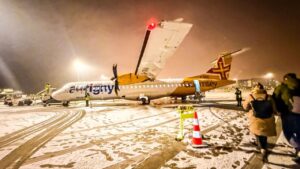
Winter brings unique challenges to island aviation, and de-icing is critical to keeping Aurigny’s operations safe and reliable. Aurigny has invested in modern de-icing infrastructure, recently using around 2,500 litres of fluid to prepare aircraft for flight.
The process is meticulous, and once an aircraft is de-iced, it isn’t always clear-cut – congestion at busy airports like London City or Gatwick can mean extended ground delays. By the time the plane is cleared for take-off, ice may have begun to form again, requiring the de-icing procedure to be repeated. It’s a time-consuming, resource-intensive process that adds cost, but there is no compromise on safety.
“We take specific and extra care to make sure the job is done properly,” Bezuidenhout says. “Safety first, always. It’s a process that can take time, but it’s absolutely non-negotiable.”
Aurigny ensures every aircraft is suited to the routes and conditions it flies, and its fleet strategy reflects this approach. In partnership with Isles of Scilly Skybus, the airline is introducing Twin Otters and gradually replacing its Dornier aircraft, ensuring every plane is optimised for the routes, the weather, and the needs of passengers.
A community airline at heart
Aurigny’s defining feature is the connection it shares with the island it serves. In larger airlines, passengers can feel like numbers. In Guernsey, they are neighbours, friends, and family.
“Every flight we operate touches someone’s life directly, whether it’s getting a child to hospital, a parent home, or a business traveller to a crucial meeting,” Bezuidenhout reflects. “That responsibility drives everything we do. You cannot fly here as if it’s just another route, it’s personal.”
Aurigny has flown uninterrupted services to Guernsey since 1968, making it one of the UK’s longest-standing aviation brands. Nearly six decades later, its purpose remains clear: to bring islanders home, connect communities, support economic activity, and deliver vital services.
In a changing regional aviation landscape, Aurigny’s story shows that when connectivity is essential, operational resilience and a strong community ethos make all the difference.